GEO and AEO for indie founders: getting your product into AI answers
People now ask ChatGPT, Claude, Perplexity and Google’s AI answers which tool to use. Generative engine optimization (GEO) and answer engine optimization (AEO) are about being the product those answers mention.

What GEO and AEO mean
Answer engine optimization (AEO) is making your pages easy to quote as a direct answer, in search features and voice assistants. Generative engine optimization (GEO) is the same idea for AI assistants that write an answer and cite sources. Both build on ordinary SEO: if search engines cannot find and understand your pages, AI answers usually cannot either.
How AI answers pick products
When someone asks “what is a good tool for X”, an AI assistant leans on pages that already answer that question clearly: comparison pages, “best tools for X” lists, product directories, documentation and your own site. Products that are described the same way in many trusted places are easier for it to recommend with confidence.
A checklist for this week
- Write one plain sentence: what it does, for whom. Use it on your homepage, launch listings and profiles.
- Add an FAQ with the real questions people ask, each answered in two or three sentences.
- Add structured data (schema.org) to your pages: your product, its price, and your FAQ.
- Publish an llms.txt that summarises your product for AI assistants.
- Get listed where answers are drawn from: launch boards, directories and comparison pages in your category.
- Write one honest comparison of your product and the best-known alternative, with who should pick which.
What a YStartUps listing already does
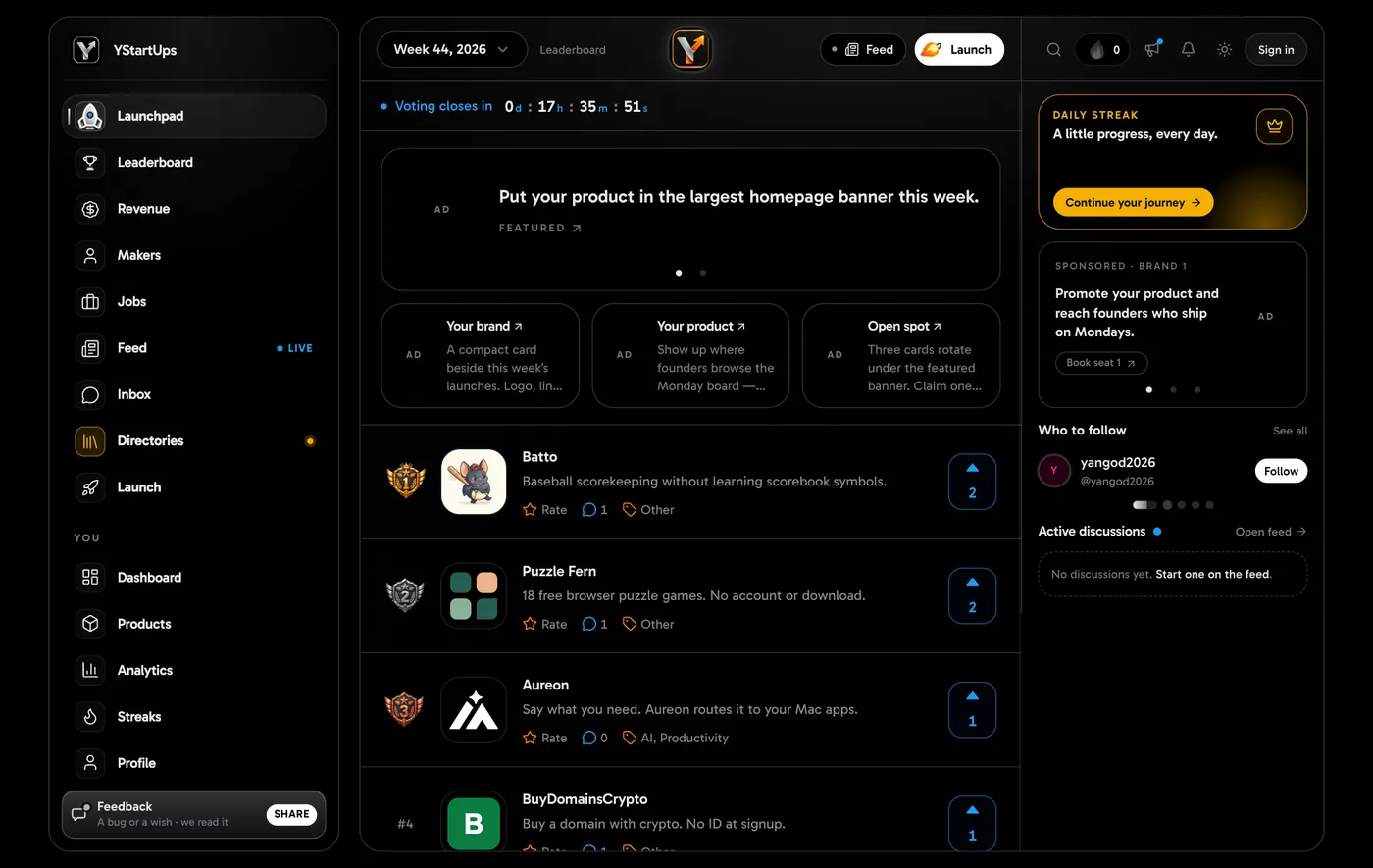
Every launch on YStartUps gets a permanent product page with structured data for your product and its rating, a markdown version that AI agents can read, and a place in our llms.txt. See why launch here, or read the citation pack playbook for the longer version.
What to expect
Nobody can promise that an AI assistant will mention you; answers change with the question, the model and the sources it reads. What you can control is being clear, consistent and present in the places those answers draw from.
More from the Journal
How a new startup gets its first backlinks
Launch listings, directories, partner pages, useful free tools and real conversations. What dofollow and nofollow mean, and which links are worth your time.
Product Hunt alternatives for indie makers
Weekly boards, maker communities and directories each give a small launch something a single day cannot. Pick by launch window, how links work and who is in the room.
Where to launch your startup in 2026 (and in what order)
A launch is not one day on one site. Use a weekly board for feedback, communities for conversations, a daily board when you have an audience, and directories for links that last.